Skip to content

Life in the Freezer

Hugh Broughton
Director

Life in the Freezer

Hugh Broughton’s essay ‘Life in the Freezer’ featured in the accompanying catalogue for the Venice Architecture Biennale's Antarctic Pavilion exhibition, Antarctopia

The Polar Regions are the coldest, driest, windiest and least populated places on earth, yet their vast unspoilt landscapes hold the key to vital earth system science, helping us to understand a vast array of scientific phenomena in the fields of geology, biology, meteorology, glaciology, astronomy and geospace science. To carry out vital research, scientists must endure the harshest conditions on our planet, living in isolated and self-sufficient research stations. Temperatures plummet below -50 degrees centigrade, winds can exceed 150 kph and for three months of the year the sun does not rise above the horizon.

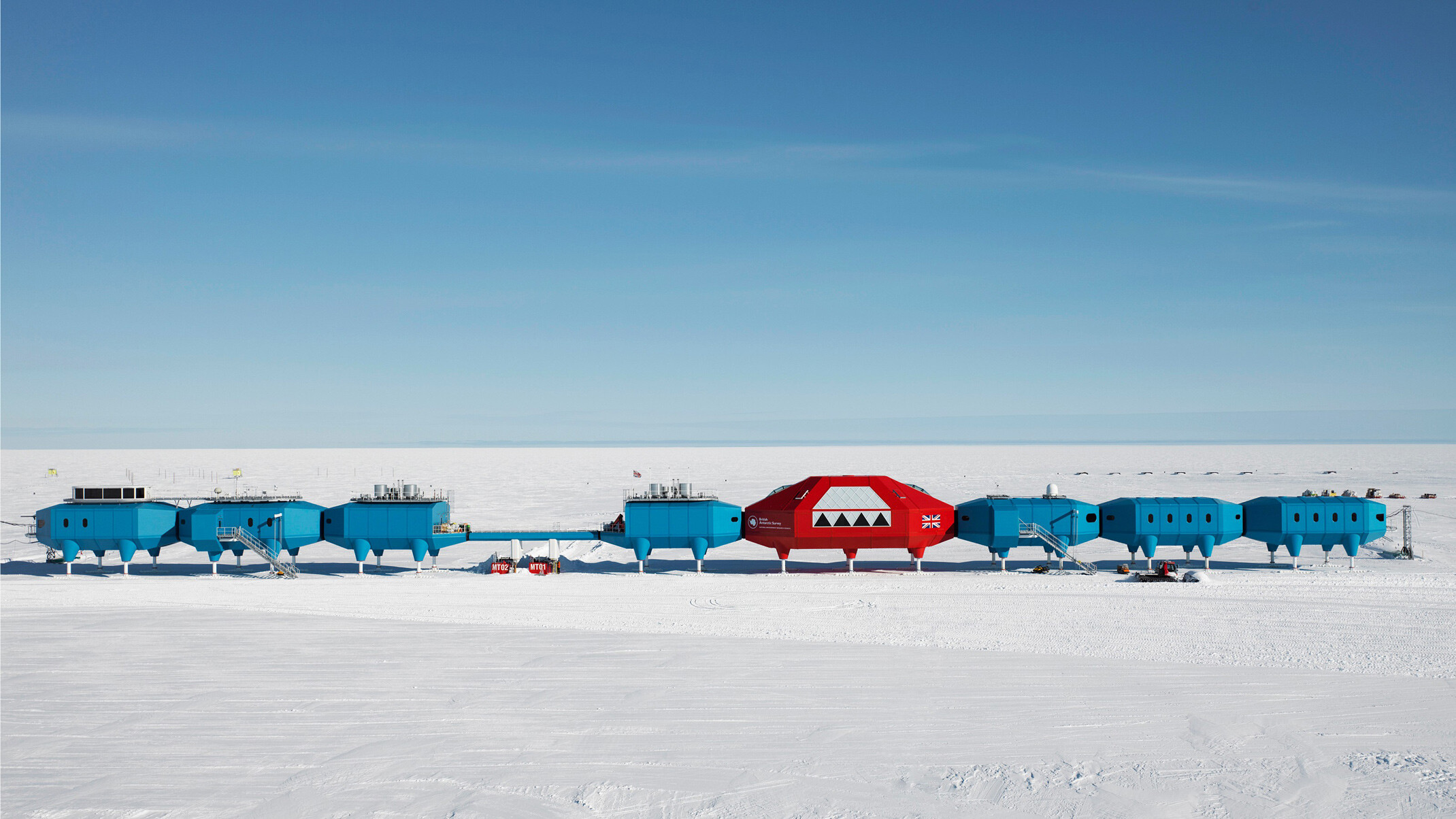
Although requirements for each base are different, in all cases stations are developed within fragile ecosystems and need to tread very lightly upon the ground, minimising impact and ensuring that the stations can be considered visitors rather than residents of these pristine environments. The creation of comfortable and psychologically supportive living space within the desert of an ice shelf is an extreme challenge only made possible by harnessing technology. Layers of innovative engineering cocoon the residents. Hoisted up on hydraulic legs, supported on giant skis and wrapped in highly insulated glass fibre skins, the station is the ultimate “Machine for Living In”, the embodiment of Archigram’s “Walking City”.

The British Antarctic Survey’s Halley VI research station
(Photography by James Morris)

Inside however space derives form and expression from age-old architectural principles – the crafting of light and volume around human activity. The design begins with simple questions: how do you wake up? What do you feel under foot when you swing out of bed? What colour is your room? How do you protect the individual whilst sustaining the community? The foundations of the space age module are the concepts, which respond to these questions.

Each bedroom has a bunk bed. Through the 9-month winter a resident gets the room to themself. In the hectic summer the room is shared. At the head of each bed is a recess for personal possessions. Set into the wall is a programmable alarm light, which uses daylight simulation to gently wake people with a false dawn, boosting mood-enhancing serotonin production. Colours have been selected with help from a colour psychologist. Hardwood veneers have been chosen as much for their pleasant natural aroma as their texture and hue. A large pin board allows for personalisation with photos of a tropical beach, the folks back home or an Emperor Penguin Colony. The desk includes a pop up make up mirror. Large, deep cupboards contain everything needed for life in the freezer. Wherever possible the design confronts the psychological deprivations experienced every day in this barren, white wilderness.

Inside the central social module at Halley VI (Photography by James Morris)

Against all the odds people are living in inspirational environments, transporting their homes into extremity. One-day Antarctica, the next into space. The future is here and now – Thunderbirds are Go!

This essay was first published in the Antarctopia catalogue to coincide with the showcasing of the first ever Antarctic Pavilion at the 14th International Architecture Exhibition, Venice Biennale (2014).
Hugh Broughton, Director
01.06.14